
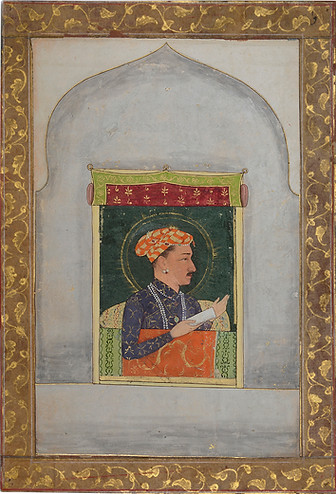
Jharoka portrait of a young prince
Mughal India, eighteenth century
Opaque pigments with gold on paper, with gold rules and a foliate border on a pale brown ground
6 2/3 by 4 in.; 16.9 by 10.4 cm. painting
7 4/5 by 5 in.; 19.8 by 13 cm. folio
PROVENANCE
Private collection, Switzerland, formed between 1970s-90s
Christie’s, London, 24 April 2015, lot 21
Rosebery’s, London, 12 June 2019, lot 54
The portrait is set at the window of a white marble palace archway. The young is seated in profile, his right arm resting on a brocade textile draped over the edge of the window, a bolster behind. He holds a firman in his right hand and his left is raised in gesture, perhaps towards the recipient. A double gilt rayed halo encircles his head, his youthful face is carefully rendered, his hair and moustache short, a double pearl earring visible. He wears a saffron and gold brocade turban draped with a string of pearls, spinels and other gems. His dark blue jama is exquisitely decorated with a gold foliate meander pattern, over it he wears a short and two long strings of pearls, the former suspended with a large ruby, and what appears to be a portrait medallion.
Jharoka portraits of the emperor originated in the seventeenth century, recalling the daily audience of the emperor when he would declaim to the public from the Diwan-i Khas at the Red Fort in Delhi. Here an unidentified Mughal prince is depicted but in the course of the eighteenth century the jharoka developed as a portrait device. Such portraits would have been placed in an album, this page forming the left-hand side of a double page spread, perhaps with a portrait of the recipient opposite.